
Penang “P” Plate: The Island’s License Plate Legacy and What Collectors Are Paying Today
In April 2026, a number plate carrying nothing more than a single digit sold for over RM1 million. The plate was P1P, part of a commemorative Penang plate series launched for JPJ’s 80th anniversary.
It wasn’t an isolated result. The full series brought in more than RM21.6 million from over 19,000 bidders inside a five-day bidding window. That number says a lot about where the Penang P plate stands today. It isn’t just a strip of metal bolted to a bumper — for a growing community of number plate collectors in Malaysia, it’s a recognised, tradeable asset with a price history people actually track.
This piece starts with that headline number, then works backward through eight decades of Penang P plate history to explain why a letter assigned to Penang under British rule still commands this kind of money in 2026.
What Collectors Are Paying for Penang P Plates Right Now
The P_P series — issued in a 1 to 9999 range — is the clearest recent snapshot of demand for Penang-linked plates. P1P topped the auction at roughly RM1.1 million. P9P followed at RM1,000,777, P8P sold for RM613,000, P6P went for RM600,777, and P2P closed at RM512,000. Out of the 9,999 numbers released, only 5,973 found buyers, leaving thousands of “running” numbers still available to the public at floor prices.
Those floor prices matter just as much as the headline figures, because they show how JPJ actually structures a Penang plate bid. Single-digit numbers open at a minimum of RM20,000. Double-digit numbers start lower, somewhere in the RM3,000 to RM5,000 range depending on how JPJ classifies them that round.
Three- and four-digit combinations with repeating or symmetrical patterns sit around RM2,500, popular but less distinctive numbers start near RM500, and ordinary running numbers can be had from as little as RM300. What pushes a number from its floor price into six figures is almost always the same thing: how few digits it has, and whether those digits read as lucky, symmetrical, or memorable.
It’s worth separating this commemorative series from the everyday Penang P plate that’s been issued continuously since long before anyone thought to brand a series for an anniversary. The P_P run is a one-off; the standard P series is the island’s actual, ongoing registration history, and that’s the legacy worth understanding next.
A Short History of the Penang “P” Plate
Penang’s vehicles were already wearing a single letter P back under the Straits Settlements, before Malaysia existed in its current form. When the rest of the peninsula’s prefixes were reorganised in 1948, Penang’s P stayed exactly as it was — no reset, no new letter.
The series simply kept counting upward: through the original combinations, into double-letter suffixes, and by 1979 into the three-letter format that’s still in use. As of mid-2026, the current Penang running number sits in the PSC range, which gives some sense of just how many vehicles have passed through this one letter over the better part of a century.
That continuity is really the whole story. A plate that started on a pre-war black-and-white design and now sits on a modern white-on-black acrylic plate is, technically, part of the same unbroken sequence. Few other state prefixes in Malaysia can claim that. It’s also why a low or early Penang P plate — the kind that’s survived from decades back rather than being freshly minted in a special series — tends to carry a different kind of weight for serious collectors. It’s not just rare, it’s old in a way that can’t be recreated.
Number Plate Collectors in Malaysia: What Draws Them to Penang’s Series
Number plate collectors in Malaysia don’t chase every prefix equally, and Penang has a few things working in its favour. The state’s large Chinese community has long shaped which numbers carry real premium, and Penang’s plates sit right in the middle of that culture — combinations built around 8 (associated with prosperity) and 9 (associated with longevity), or numbers that repeat or mirror themselves, consistently draw stronger bidding than anything chosen at random. Readers curious about why specific digits carry that weight can find a fuller breakdown in our guide to lucky car plates and feng shui number meanings.
There’s also a status element that goes beyond superstition. A short, clean Penang plate is instantly recognisable on the road in a way a standard three-letter, four-digit combination isn’t, and that visibility is part of what collectors are actually paying for. We’ve covered this dynamic in more depth in our piece on the psychology behind VIP plates, but the short version is that scarcity plus instant recognition is a combination collectors will consistently pay above the listed floor price to secure.
Inside the JPJ Bidding Process for Penang Numbers
Every JPJ Penang number plate that goes to public bidding moves through the same platform: JPJeBid. Numbers are sorted into tiers before bidding even opens — broadly Golden (single and very low digits), Premium, Attractive, Popular, and Running — and each tier carries its own minimum bid and minimum increment. Once bidding closes, winners typically have around 12 months to register their new number onto an actual vehicle, and anything that didn’t attract a winning bid gets released back to the public at its original floor price.
This is the same structure that produced the P_P results above, and it’s also how the standard Penang P series gets refreshed whenever JPJ pulls a batch of low or attractive numbers out of the regular running sequence. If you want to walk through the bidding mechanics step by step, our JPJeBid guide for 2026 covers the platform in detail, and for a sense of just how far prices can run when a series catches on, our roundup of shocking JPJ winning bids is worth a look.
Buying or Transferring an Existing Penang Plate
Not every Penang P plate that changes hands goes through a fresh JPJ auction. Registration numbers in Malaysia can legally be transferred from one vehicle to another or sold privately between owners, which is exactly how a lot of older, low-digit P plates stay in circulation decades after they were first issued.
If you’re going this route rather than waiting on the next JPJeBid round, our guide to buying a car plate the legal way walks through the proper channels, and our breakdown of common scams in the used plate market is worth reading before any money changes hands. For owners moving a number between two of their own vehicles, the process is slightly different again, which our car plate interchange guide explains step by step.
How Penang’s Legacy Compares to Other State Plates
Penang isn’t the only state with a prefix that’s built up its own following. Johor’s J plate is approaching its own milestone as it transitions further into digital registration, Selangor’s B plate has quietly become one of the most coveted prefixes in the country given how many vehicles the state registers each year, and Kuala Lumpur’s W plate has its own long climb from an ordinary city prefix to one associated with serious money.
What sets the Penang P plate apart is the unbroken nature of its single letter — no reset in 1948, no rebranding, just one continuous count from the colonial era to today. Readers comparing prefixes might also enjoy our histories of the Johor J plate, the Selangor B plate, and the KL W plate.
Is a Penang P Plate Worth Collecting in 2026?
Treat this the way most experienced collectors do: as a market driven by genuine cultural demand rather than guaranteed appreciation. A low-digit or pattern-rich Penang P plate has real, demonstrated buyer interest, and the P_P results show that’s just as true in 2026 as it’s ever been. But not every number is worth a premium, and a plate’s eventual value still depends on its specific digits, its documented history, and who happens to be bidding the week it comes up.
If you’re new to this and want to avoid the more obvious mistakes, our rundown of pitfalls first-time VIP plate buyers should avoid is a sensible place to start, and you’re welcome to browse real examples in our number plate gallery or get in touch if you’re tracking a specific Penang P plate number.
Penang “P” Plate: The Island’s License Plate Legacy and What Collectors Are Paying Today
In April 2026, a number plate carrying nothing more than a single digit sold for over RM1 million. The plate was P1P, part of a commemorative Penang plate series launched for JPJ’s 80th anniversary.
It wasn’t an isolated result. The full series brought in more than RM21.6 million from over 19,000 bidders inside a five-day bidding window. That number says a lot about where the Penang P plate stands today. It isn’t just a strip of metal bolted to a bumper — for a growing community of number plate collectors in Malaysia, it’s a recognised, tradeable asset with a price history people actually track.
This piece starts with that headline number, then works backward through eight decades of Penang P plate history to explain why a letter assigned to Penang under British rule still commands this kind of money in 2026.
What Collectors Are Paying for Penang P Plates Right Now
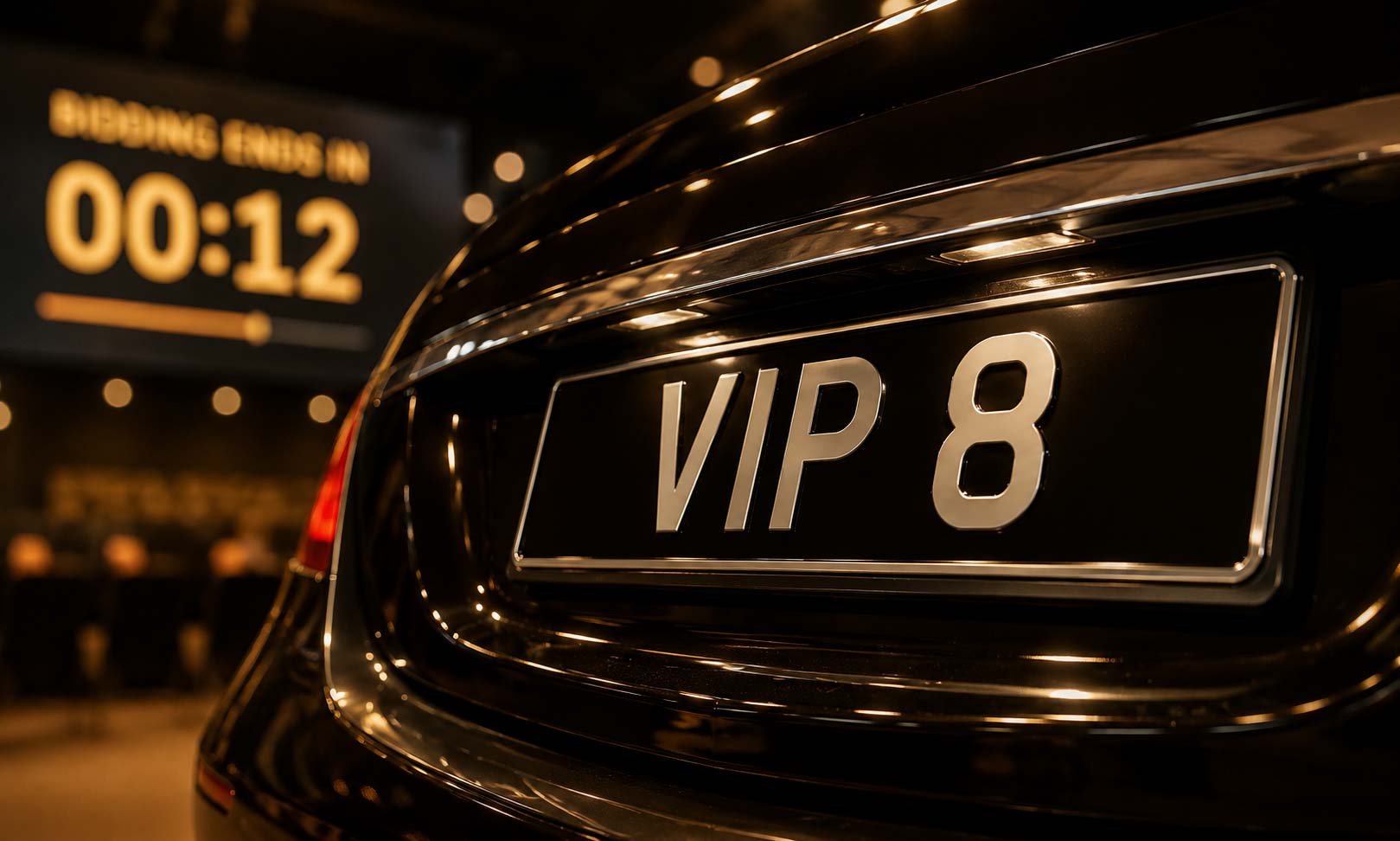
The P_P series — issued in a 1 to 9999 range — is the clearest recent snapshot of demand for Penang-linked plates. P1P topped the auction at roughly RM1.1 million. P9P followed at RM1,000,777, P8P sold for RM613,000, P6P went for RM600,777, and P2P closed at RM512,000. Out of the 9,999 numbers released, only 5,973 found buyers, leaving thousands of “running” numbers still available to the public at floor prices.
Those floor prices matter just as much as the headline figures, because they show how JPJ actually structures a Penang plate bid. Single-digit numbers open at a minimum of RM20,000. Double-digit numbers start lower, somewhere in the RM3,000 to RM5,000 range depending on how JPJ classifies them that round.
Three- and four-digit combinations with repeating or symmetrical patterns sit around RM2,500, popular but less distinctive numbers start near RM500, and ordinary running numbers can be had from as little as RM300. What pushes a number from its floor price into six figures is almost always the same thing: how few digits it has, and whether those digits read as lucky, symmetrical, or memorable.
It’s worth separating this commemorative series from the everyday Penang P plate that’s been issued continuously since long before anyone thought to brand a series for an anniversary. The P_P run is a one-off; the standard P series is the island’s actual, ongoing registration history, and that’s the legacy worth understanding next.
A Short History of the Penang “P” Plate
Penang’s vehicles were already wearing a single letter P back under the Straits Settlements, before Malaysia existed in its current form. When the rest of the peninsula’s prefixes were reorganised in 1948, Penang’s P stayed exactly as it was — no reset, no new letter.
The series simply kept counting upward: through the original combinations, into double-letter suffixes, and by 1979 into the three-letter format that’s still in use. As of mid-2026, the current Penang running number sits in the PSC range, which gives some sense of just how many vehicles have passed through this one letter over the better part of a century.
That continuity is really the whole story. A plate that started on a pre-war black-and-white design and now sits on a modern white-on-black acrylic plate is, technically, part of the same unbroken sequence. Few other state prefixes in Malaysia can claim that. It’s also why a low or early Penang P plate — the kind that’s survived from decades back rather than being freshly minted in a special series — tends to carry a different kind of weight for serious collectors. It’s not just rare, it’s old in a way that can’t be recreated.
Number Plate Collectors in Malaysia: What Draws Them to Penang’s Series
Number plate collectors in Malaysia don’t chase every prefix equally, and Penang has a few things working in its favour. The state’s large Chinese community has long shaped which numbers carry real premium, and Penang’s plates sit right in the middle of that culture — combinations built around 8 (associated with prosperity) and 9 (associated with longevity), or numbers that repeat or mirror themselves, consistently draw stronger bidding than anything chosen at random. Readers curious about why specific digits carry that weight can find a fuller breakdown in our guide to lucky car plates and feng shui number meanings.
There’s also a status element that goes beyond superstition. A short, clean Penang plate is instantly recognisable on the road in a way a standard three-letter, four-digit combination isn’t, and that visibility is part of what collectors are actually paying for. We’ve covered this dynamic in more depth in our piece on the psychology behind VIP plates, but the short version is that scarcity plus instant recognition is a combination collectors will consistently pay above the listed floor price to secure.
Inside the JPJ Bidding Process for Penang Numbers
Every JPJ Penang number plate that goes to public bidding moves through the same platform: JPJeBid. Numbers are sorted into tiers before bidding even opens — broadly Golden (single and very low digits), Premium, Attractive, Popular, and Running — and each tier carries its own minimum bid and minimum increment. Once bidding closes, winners typically have around 12 months to register their new number onto an actual vehicle, and anything that didn’t attract a winning bid gets released back to the public at its original floor price.
This is the same structure that produced the P_P results above, and it’s also how the standard Penang P series gets refreshed whenever JPJ pulls a batch of low or attractive numbers out of the regular running sequence. If you want to walk through the bidding mechanics step by step, our JPJeBid guide for 2026 covers the platform in detail, and for a sense of just how far prices can run when a series catches on, our roundup of shocking JPJ winning bids is worth a look.
Buying or Transferring an Existing Penang Plate
Not every Penang P plate that changes hands goes through a fresh JPJ auction. Registration numbers in Malaysia can legally be transferred from one vehicle to another or sold privately between owners, which is exactly how a lot of older, low-digit P plates stay in circulation decades after they were first issued.
If you’re going this route rather than waiting on the next JPJeBid round, our guide to buying a car plate the legal way walks through the proper channels, and our breakdown of common scams in the used plate market is worth reading before any money changes hands. For owners moving a number between two of their own vehicles, the process is slightly different again, which our car plate interchange guide explains step by step.
How Penang’s Legacy Compares to Other State Plates
Penang isn’t the only state with a prefix that’s built up its own following. Johor’s J plate is approaching its own milestone as it transitions further into digital registration, Selangor’s B plate has quietly become one of the most coveted prefixes in the country given how many vehicles the state registers each year, and Kuala Lumpur’s W plate has its own long climb from an ordinary city prefix to one associated with serious money.
What sets the Penang P plate apart is the unbroken nature of its single letter — no reset in 1948, no rebranding, just one continuous count from the colonial era to today. Readers comparing prefixes might also enjoy our histories of the Johor J plate, the Selangor B plate, and the KL W plate.
Is a Penang P Plate Worth Collecting in 2026?
Treat this the way most experienced collectors do: as a market driven by genuine cultural demand rather than guaranteed appreciation. A low-digit or pattern-rich Penang P plate has real, demonstrated buyer interest, and the P_P results show that’s just as true in 2026 as it’s ever been. But not every number is worth a premium, and a plate’s eventual value still depends on its specific digits, its documented history, and who happens to be bidding the week it comes up.
If you’re new to this and want to avoid the more obvious mistakes, our rundown of pitfalls first-time VIP plate buyers should avoid is a sensible place to start, and you’re welcome to browse real examples in our number plate gallery or get in touch if you’re tracking a specific Penang P plate number.